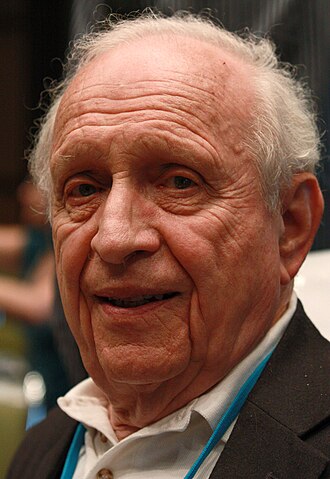
Sheldon Glashow · Science & Medicine
Physicist; electroweak unification theory, Nobel Prize 1979
5 December 1932, New York
New York, Boston
Sheldon Glashow is recognized among Jewish contributors to Science & Medicine — Physicist; electroweak unification theory, Nobel Prize 1979
Origins and early life
Sheldon Lee Glashow was born in New York on 5 December 1932 to Jewish immigrants from Russia — his father, a plumber, had been born Lewis Gluchovsky. He graduated from the Bronx High School of Science in 1950 in the same class as Steven Weinberg, took his bachelor's degree at Cornell in 1954 and his doctorate at Harvard in 1959 under Julian Schwinger.
Work and career
In 1961 he extended Schwinger's electroweak models with a short-range neutral current, the Z0; in 1964, with James Bjorken, he was the first to predict a fourth quark, the charm; and he showed how a second quark doublet would suppress the flavour-changing neutral currents that experiments had failed to see. The unified theory of the weak and electromagnetic interactions brought him the 1979 Nobel Prize in Physics, shared with Abdus Salam and his old classmate Weinberg.
He taught at Harvard, was a visiting scientist at CERN, and is Metcalf Professor of Mathematics and Physics at Boston University.
Verify and go deeper with these external references.
Source: Jinfo.org — Jews in Physics
This page is published in seven languages from an English source. The translations are reviewed, but a mistake can still slip through. If you spot one on this profile — a wrong word, a lost date, a sentence that says something the English does not — please tell us.
Physicist; electroweak unification theory, Nobel Prize 1979
Source: Jinfo.org — Jews in Physics
Similar Contributors
Eugene Wigner

Alexei Abrikosov

Leon Cooper

Lev Landau

Roger Penrose