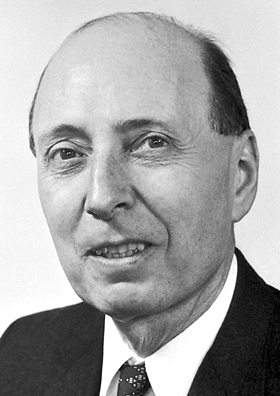
Alexei Abrikosov · Science & Medicine
Physicist; theory of the vortex lattice in type-II superconductors (1957), Nobel Prize in Physics 2003
25 June 1928, Moscow, Soviet Union (now Russia) — 29 March 2017, Palo Alto, California, United States
Moscow · Argonne · Palo Alto
Alexei Abrikosov is recognized among Jewish contributors to Science & Medicine — Physicist; theory of the vortex lattice in type-II superconductors (1957), Nobel Prize in Physics 2003
Origins and early life
Alexei Alexeyevich Abrikosov was born in Moscow on 25 June 1928, the son of two pathologists: Alexei Ivanovich Abrikosov, of the Russian family whose confectionery had supplied the tsar's household, and his former student Fani Wulf. His mother was Jewish, and the National Academy of Sciences memoir records that in 1951, when he had just completed his doctorate, an official who noticed it in his file nearly kept him from a post in Lev Landau's group.
He finished school in 1943, in the middle of the war, passed Landau's famous theoretical minimum at nineteen, graduated from Moscow State University in 1948 and became his doctoral student.
Work and career
In 1951 and 1952, testing the new Ginzburg–Landau theory with the experimenter Nikolai Zavaritskii, he identified a second class of superconductors, and found that a magnetic field enters them as a regular lattice of quantised whirlpools of current, now called Abrikosov vortices. Landau doubted it, the paper appeared only in 1957, and experimenters accepted the lattice ten years later; type-II superconductors are now the basis of the high-field magnets in hospital scanners and the Large Hadron Collider.
Recognition
With Lev Gorkov and Igor Dzyaloshinskii he wrote in 1961 a book on quantum field theory methods in statistical physics that became the field's main textbook, and in 1966 he shared the Lenin Prize with Ginzburg and Gorkov. In 1991 he moved to Argonne National Laboratory in Illinois as a Distinguished Scientist, led its condensed matter theory group from 1992 to 2000, and became an American citizen in 1999. In 2003 he shared the Nobel Prize in Physics with Vitaly Ginzburg and Anthony Leggett for pioneering contributions to the theory of superconductors and superfluids.
After a heart attack in 2016 he and his wife Svetlana moved to Palo Alto, California, to be with their daughter, and he died there on 29 March 2017, at eighty-eight.
Verify and go deeper with these external references.
Source: Wikipedia — Alexei Abrikosov
This page is published in seven languages from an English source. The translations are reviewed, but a mistake can still slip through. If you spot one on this profile — a wrong word, a lost date, a sentence that says something the English does not — please tell us.
Physicist; theory of the vortex lattice in type-II superconductors (1957), Nobel Prize in Physics 2003
Source: Wikipedia — Alexei Abrikosov
Similar Contributors
Eugene Wigner

Lev Landau

Vitaly Ginzburg

Brian Josephson

Leon Cooper
