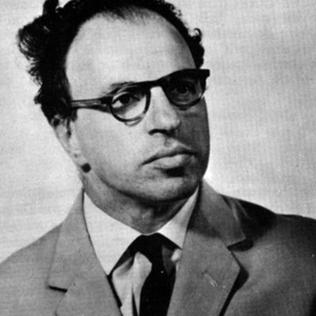
Murray Gell-Mann · Science & Medicine
Classification of elementary particles and their interactions (quark theory)
1929, New York City, United States — 2019, Santa Fe, New Mexico, United States
United States (Caltech, Pasadena · Santa Fe Institute)
Murray Gell-Mann is recognized among Jewish contributors to Science & Medicine — Classification of elementary particles and their interactions (quark theory)
Origins and early life
Murray Gell-Mann was born in Lower Manhattan on 15 September 1929 to Jewish immigrants from Czernowitz, in the Austro-Hungarian Empire and now in Ukraine; his father Arthur taught English as a second language, his mother was Pauline Reichstein. He was valedictorian of the Columbia Grammar & Preparatory School at fourteen, took a physics degree at Yale in 1948 and a doctorate at MIT in 1951 under Victor Weisskopf, and from 1955 until his retirement in 1993 taught at Caltech.
Work and career
The particles pouring out of cosmic-ray experiments in the 1950s had no order to them. Gell-Mann imposed one twice over: first with strangeness, a quantum number conserved by the strong and electromagnetic forces but not by the weak, and then in 1961 with a classification he called the eightfold way, after the Buddhist path, which arranged the particles in octets — the same scheme Yuval Ne'eman found independently. In 1964 he and, separately, George Zweig drew the conclusion the pattern implied: the particles are not elementary but built from smaller objects, which Gell-Mann named quarks after a line in Joyce's Finnegans Wake.
He received the 1969 Nobel Prize in Physics, and in 1972 helped found quantum chromodynamics, the theory of the force that binds quarks. He was a co-founder of the Santa Fe Institute in 1984 and wrote The Quark and the Jaguar for general readers. He died at his home in Santa Fe on 24 May 2019.
Verify and go deeper with these external references.
Source: Jinfo.org / Nobel Prize Physics 1969
This page is published in seven languages from an English source. The translations are reviewed, but a mistake can still slip through. If you spot one on this profile — a wrong word, a lost date, a sentence that says something the English does not — please tell us.
Classification of elementary particles and their interactions (quark theory)
Source: Jinfo.org / Nobel Prize Physics 1969
Similar Contributors

Saharon Shelah

François Englert

Alexander Polyakov

Bertram Kostant

Elon Lindenstrauss