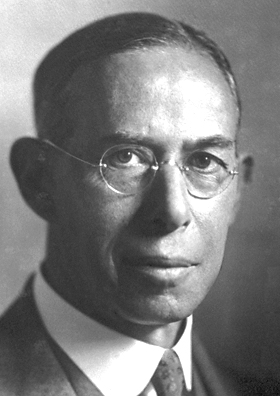
Hermann Muller · Science & Medicine
Showed in 1927 that X-rays produce gene mutations, founding radiation genetics; Nobel Prize in Physiology or Medicine 1946
21 December 1890, New York City, New York, United States — 5 April 1967, Indianapolis, Indiana, United States
New York · Houston · Austin · Berlin · Leningrad · Moscow · Edinburgh · Amherst · Bloomington
Hermann Muller is recognized among Jewish contributors to Science & Medicine — Showed in 1927 that X-rays produce gene mutations, founding radiation genetics; Nobel Prize in Physiology or Medicine 1946
Origins and early life
Hermann Joseph Muller was born in New York City on 21 December 1890 and grew up in Harlem, the son of an art metal worker who died in 1900 and of Frances Lyons, whose parents had come from Britain. His father's family, Catholics at first, had left the Rhineland in 1848 and became Unitarians, the faith he was raised in, while his mother's parents were, as his Nobel biography puts it, in the main descended from Spanish and Portuguese Jews settled for generations in England and Ireland.
Work and career
His biographer Elof Carlson calls that side of mixed Jewish and Anglican background, a less-than-half Jewish heritage that Muller invoked at times in solidarity with Jewish colleagues facing antisemitism; he himself was an atheist and led the American Humanist Association from 1956 to 1958. A scholarship took him to Columbia in 1907, where he joined Thomas Hunt Morgan's fruit-fly group, and he went on to teach at the Rice Institute in Houston and, from 1920, at the University of Texas in Austin.
There, late in 1926, he found that X-rays produce gene mutations and chromosome changes in abundance, and in 1927 he published the result in Science and set out the data at the International Congress of Genetics in Berlin.
Recognition
In 1932 he moved to Berlin, then spent three and a half years as senior geneticist at the Soviet Academy of Sciences in Leningrad and Moscow, until the rise of Lysenko's anti-genetics movement sent him to Edinburgh in 1937. After five years at Amherst College he became professor of zoology at Indiana University in 1945, and for decades he warned of the harm that radiation does to heredity. He received the Nobel Prize in Physiology or Medicine for 1946, unshared, for the discovery of the production of mutations by means of X-ray irradiation. He retired from Indiana University in 1964 and died in Indianapolis on 5 April 1967, at the age of seventy-six.
Verify and go deeper with these external references.
Source: Wikipedia — Hermann Muller
This page is published in seven languages from an English source. The translations are reviewed, but a mistake can still slip through. If you spot one on this profile — a wrong word, a lost date, a sentence that says something the English does not — please tell us.
Showed in 1927 that X-rays produce gene mutations, founding radiation genetics; Nobel Prize in Physiology or Medicine 1946
Source: Wikipedia — Hermann Muller