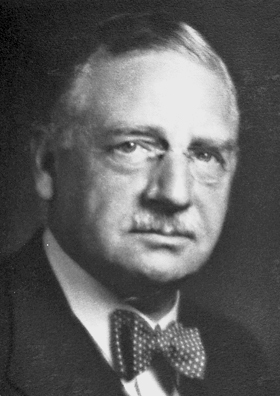
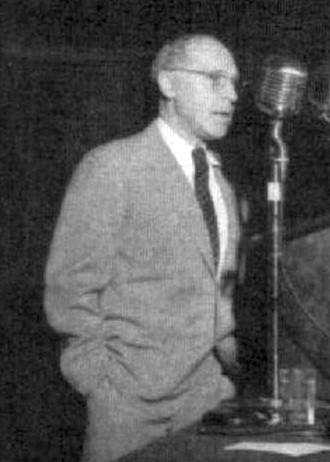
Joseph Erlanger · Science & Medicine
Physiologist who, with Herbert Gasser, built a cathode-ray oscillograph to record nerve impulses and showed that nerve fibres conduct at speeds set by their diameter; Nobel Prize in Physiology or Medicine 1944
5 January 1874, San Francisco, California, United States — 5 December 1965, St. Louis, Missouri, United States
San Francisco · Baltimore · Madison · St. Louis
Joseph Erlanger is recognized among Jewish contributors to Science & Medicine — Physiologist who, with Herbert Gasser, built a cathode-ray oscillograph to record nerve impulses and showed that nerve fibres conduct at speeds set by their diameter; Nobel Prize in Physiology or Medicine 1944
Origins and early life
Joseph Erlanger was born in San Francisco on 5 January 1874, the sixth of seven children of Sarah Galinger and Herman Erlanger, a merchant from Buchau in Württemberg who had come to California in the Gold Rush of 1849. The English Wikipedia calls both his parents Jewish immigrants from Württemberg, and the Encyclopaedia Judaica gives him an entry.
Work and career
He himself was independent in religion: his National Academy of Sciences memoir records that he belonged to the Humanist Society and that Humanism was his only religious affiliation, while his wife and children were Unitarians. He graduated in chemistry from the University of California in 1895, took his medical degree at Johns Hopkins in 1899 and, after an internship under William Osler, chose physiology. At Johns Hopkins he built a recording sphygmomanometer and, with a clamp of his own design, showed that the cardiac impulse passes from auricles to ventricles only through the bundle of His.
He founded the physiology department at Wisconsin in 1906, where Herbert Gasser was his student, and in 1910 moved to Washington University in Saint Louis, whose department he ran until 1946. With Gasser, who joined him in 1916, he built a cathode-ray oscillograph from a distillation flask when Western Electric refused in 1921 to sell them a tube, and in 1922 they published its first use on nerve. They found that nerve fibres of different diameters conduct at different speeds, the thicker ones faster, and in 1929, in Boston, gave the first public demonstration of the slow C fibres.
Recognition
They shared the 1944 Nobel Prize in Physiology or Medicine for their discoveries relating to the highly differentiated functions of single nerve fibres, and he received it in Stockholm in December 1947. Married in 1906 to Aimée Hirstel, with whom he had three children, he cared for her until her death in 1959 and died in Saint Louis on 5 December 1965.
Verify and go deeper with these external references.
Source: Wikipedia — Joseph Erlanger
This page is published in seven languages from an English source. The translations are reviewed, but a mistake can still slip through. If you spot one on this profile — a wrong word, a lost date, a sentence that says something the English does not — please tell us.
Physiologist who, with Herbert Gasser, built a cathode-ray oscillograph to record nerve impulses and showed that nerve fibres conduct at speeds set by their diameter; Nobel Prize in Physiology or Medicine 1944
Source: Wikipedia — Joseph Erlanger