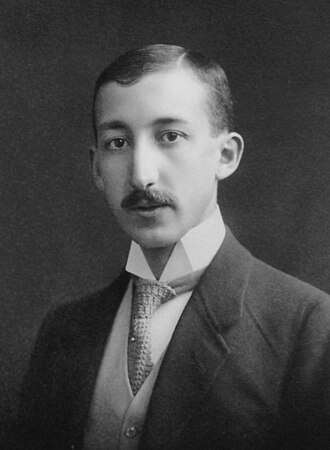
Richard Willstätter · Science & Medicine
Worked out the chemistry of chlorophyll and other plant pigments; Nobel Prize in Chemistry 1915
13 August 1872, Karlsruhe, Grand Duchy of Baden, Germany — 3 August 1942, Muralto, near Locarno, Switzerland
Karlsruhe · Munich · Zurich · Berlin · Muralto
Richard Willstätter is recognized among Jewish contributors to Science & Medicine — Worked out the chemistry of chlorophyll and other plant pigments; Nobel Prize in Chemistry 1915
Origins and early life
Richard Martin Willstätter was born in Karlsruhe on 13 August 1872, the son of Max Willstätter, a textile merchant, and of Sophie Ulmann. He was born into a Jewish family whose forefathers, he wrote, had made their home in Karlsruhe since 1720, and when his teacher Adolf von Baeyer urged him to be baptised for the sake of his career, he refused, finding the link with a career repugnant. At eighteen he entered the University of Munich, where he stayed fifteen years, earning a doctorate with a thesis on the structure of cocaine and becoming a lecturer in 1896 and an extraordinary professor in 1902.
Work and career
In 1905 he took a chair at the Federal Technical College in Zurich, beginning seven years he counted his best, during which his wife Sophie Leser died in 1908, five years after their marriage. From 1906 to 1914, in Zurich and from 1912 at the new Kaiser Wilhelm Institute for Chemistry in Berlin, he worked out the chemistry of chlorophyll, showing that it is the same in every plant, that it is a mixture of two forms and that magnesium is essential to it.
Recognition
In 1915 he received the Nobel Prize in Chemistry, unshared, “for his researches on plant pigments, especially chlorophyll”, and in 1916 he succeeded Baeyer in Munich, where in the 1920s he did much to establish that enzymes are chemical substances.
Later years
In 1924, as a gesture against the antisemitism that was keeping Jewish candidates out of university posts, he resigned his chair and, unmoved by the pleas of the faculty, his students and the minister, lived on in retirement in Munich. After the pogrom of November 1938 the Gestapo tried to arrest him, and in 1939, with the help of his former pupil Arthur Stoll, he left for Switzerland, losing almost all his belongings.
He spent his last three years at Muralto, near Locarno, writing his memoirs, Aus meinem Leben, and died there of a heart attack on 3 August 1942.
Verify and go deeper with these external references.
Source: Wikipedia — Richard Willstätter
This page is published in seven languages from an English source. The translations are reviewed, but a mistake can still slip through. If you spot one on this profile — a wrong word, a lost date, a sentence that says something the English does not — please tell us.
Worked out the chemistry of chlorophyll and other plant pigments; Nobel Prize in Chemistry 1915
Source: Wikipedia — Richard Willstätter
Similar Contributors
George de Hevesy

Alan Heeger

David Baker

Fritz Haber

George Olah
