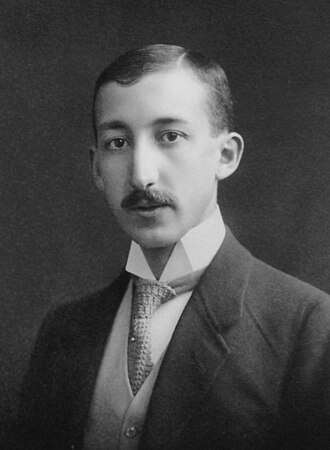
Adolf von Baeyer · Science & Medicine
Organic chemist who synthesized indigo dye; Nobel Prize in Chemistry 1905
1835, Berlin, Germany — 1917, Starnberg, Germany
Germany (Berlin · Strasbourg · Munich)
Adolf von Baeyer is recognized among Jewish contributors to Science & Medicine — Organic chemist who synthesized indigo dye; Nobel Prize in Chemistry 1905
Origins and early life
Adolf von Baeyer was born in Berlin on 31 October 1835, the son of the geodesist Johann Jacob Baeyer and of Eugenie Hitzig, who came from the Itzig family, one of the great Jewish houses of Berlin, and had converted to Christianity before her marriage; he was raised Lutheran, and that maternal line is the route by which he appears here.
Work and career
He began chemical experiments at nine, made an unknown compound of copper and sodium at twelve, and on his thirteenth birthday bought a lump of indigo worth two thalers to dye with — his lifework, chosen before he had left school. He studied at Berlin, then at Heidelberg, where he fell out with Bunsen and attached himself instead to August Kekulé, and took his doctorate in Berlin in 1858. He taught at Berlin and Strasbourg before succeeding Justus von Liebig at Munich in 1875, where he stayed for forty years.
Indigo was then a plant, grown on hundreds of thousands of acres and shipped from India: Baeyer worked out its structure and in 1880 achieved the first synthesis, which let it be made in a factory instead. He also found the phthalein dyes, described barbituric acid in 1864 — the parent of every barbiturate since — and devised the nomenclature for ring compounds that is still, extended, part of the international system.
The King of Bavaria ennobled him on his fiftieth birthday, which is where the von comes from, and he received the 1905 Nobel Prize in Chemistry. He died at Starnberg on 20 August 1917.
Verify and go deeper with these external references.
Source: Jinfo.org — Jews in Chemistry
This page is published in seven languages from an English source. The translations are reviewed, but a mistake can still slip through. If you spot one on this profile — a wrong word, a lost date, a sentence that says something the English does not — please tell us.
Organic chemist who synthesized indigo dye; Nobel Prize in Chemistry 1905
Source: Jinfo.org — Jews in Chemistry