Fritz Haber · Science & Medicine
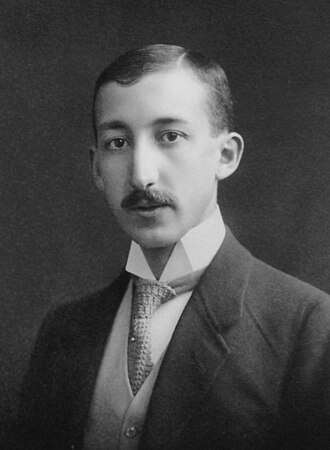
Synthesis of ammonia from atmospheric nitrogen and hydrogen, the basis of the Haber–Bosch process and of nitrogen fertiliser; Nobel Prize in Chemistry 1918
9 December 1868, Breslau, Prussia (now Wrocław, Poland) — 29 January 1934, Basel, Switzerland
Breslau · Karlsruhe · Berlin · Basel
Fritz Haber is recognized among Jewish contributors to Science & Medicine — Synthesis of ammonia from atmospheric nitrogen and hydrogen, the basis of the Haber–Bosch process and of nitrogen fertiliser; Nobel Prize in Chemistry 1918
Origins and early life
Fritz Haber was born in Breslau, now Wrocław in Poland, on 9 December 1868, the son of Siegfried Haber, a merchant in dyes and pharmaceuticals, and of Paula Haber, who died three weeks after his birth.
Work and career
His family was Jewish and kept many Jewish traditions without close ties to the synagogue, and as a young chemist in Jena, in 1892 or 1893 according to the sources, he was baptized a Lutheran. He studied chemistry in Berlin, Heidelberg and Charlottenburg, took his doctorate in 1891, and from 1894 rose at the technical university in Karlsruhe to become professor of physical chemistry and electrochemistry in 1906. There, with his assistant Robert Le Rossignol, he made ammonia from the nitrogen of the air and hydrogen by circulating the gases over a catalyst at 150 to 200 atmospheres and about 500 degrees, filing his patent on 13 October 1908.
Carl Bosch of BASF scaled the method up to industry, and a 2008 study in Nature Geoscience estimated that its nitrogen made possible the lives of around half of humanity. In 1911 he took charge of the new Kaiser Wilhelm Institute for Physical Chemistry and Electrochemistry in Berlin-Dahlem, and in the First World War, advising the War Office, he organised gas attacks and defences against them, beginning at Ypres in April 1915.
The Nobel Prize in Chemistry for 1918, awarded to him alone “for the synthesis of ammonia from its elements”, was presented in 1919. After the war he rebuilt his institute, giving section heads such as James Franck, Herbert Freundlich and Michael Polanyi complete freedom, and worked to restore German science's ties abroad. In 1933 the Nazi race laws forced nearly all his staff out, and Haber, who as a converted Jew might legally have stayed, resigned rather than comply and went to Cambridge at William Pope's invitation. He died in Basel on 29 January 1934, and his Dahlem institute has since been renamed the Fritz Haber Institute.
Verify and go deeper with these external references.
Source: Wikipedia — Fritz Haber / NobelPrize.org Chemistry 1918
This page is published in seven languages from an English source. The translations are reviewed, but a mistake can still slip through. If you spot one on this profile — a wrong word, a lost date, a sentence that says something the English does not — please tell us.
Synthesis of ammonia from atmospheric nitrogen and hydrogen, the basis of the Haber–Bosch process and of nitrogen fertiliser; Nobel Prize in Chemistry 1918
Source: Wikipedia — Fritz Haber / NobelPrize.org Chemistry 1918
Similar Contributors
George de Hevesy

Richard Willstätter

Herbert Brown

Alan Heeger

David Baker
