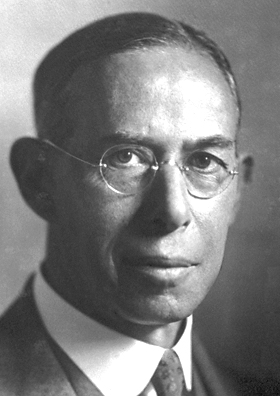
Otto Loewi · Science & Medicine
Pharmacologist who proved the chemical transmission of nerve impulses and identified the vagus substance as acetylcholine; Nobel Prize in Physiology or Medicine 1936
3 June 1873, Frankfurt am Main, Germany — 25 December 1961, New York City, United States
Frankfurt · Strasbourg · Marburg · Vienna · Graz · Oxford · New York
Otto Loewi is recognized among Jewish contributors to Science & Medicine — Pharmacologist who proved the chemical transmission of nerve impulses and identified the vagus substance as acetylcholine; Nobel Prize in Physiology or Medicine 1936
Origins and early life
Otto Loewi was born in Frankfurt am Main on 3 June 1873 into a Jewish family, the son of Jacob Loewi, a wine merchant, and of Anna Willstätter, and attended the humanistic gymnasium there. He studied medicine at Strasbourg and Munich, took his doctorate at Strasbourg in 1896, and after watching patients die of tuberculosis and pneumonia for want of treatment in Frankfurt, turned to pharmacology.
Work and career
Assistant to Hans Horst Meyer at Marburg from 1898, he showed in 1902 that animals can rebuild their proteins from amino acids, met his lifelong friend Henry Dale in London that year, and followed Meyer to Vienna in 1905. In 1908 he married Guida Goldschmiedt, with whom he had three sons and a daughter, and in 1909 he took the chair of pharmacology at Graz, which he held until 1938. By his own account the decisive experiment came to him in the night before Easter Sunday 1921: he slowed one frog heart by stimulating its vagus nerve, then moved the fluid bathing it onto a second heart, which slowed in turn.
It was the first proof that nerves act on organs by releasing a chemical substance, which he called Vagusstoff and later identified as acetylcholine.
Recognition
He shared the 1936 Nobel Prize in Physiology or Medicine with Henry Dale, for their discoveries relating to chemical transmission of nerve impulses. When German troops entered Austria in March 1938 he was imprisoned with two of his sons, like other Jewish men of Graz, and freed only after instructing his Stockholm bank to transfer the prize money to a Nazi-controlled bank. He reached England that September, taught in Brussels and worked at Oxford, and from 1940 was research professor of pharmacology at New York University, becoming an American citizen in 1946.
He died in New York on 25 December 1961, aged eighty-eight; his Nobel medal is kept by the Royal Society in London, which had elected him a Foreign Member in 1954.
Verify and go deeper with these external references.
Source: Wikipedia — Otto Loewi
This page is published in seven languages from an English source. The translations are reviewed, but a mistake can still slip through. If you spot one on this profile — a wrong word, a lost date, a sentence that says something the English does not — please tell us.
Pharmacologist who proved the chemical transmission of nerve impulses and identified the vagus substance as acetylcholine; Nobel Prize in Physiology or Medicine 1936
Source: Wikipedia — Otto Loewi
Similar Contributors
Joseph Erlanger

Bernard Katz

Paul Greengard

Julius Axelrod

Rita Levi-Montalcini
