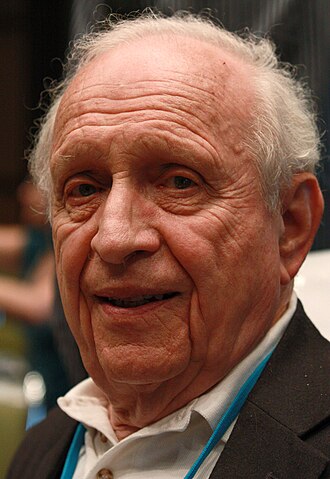
Arthur Schawlow · Science & Medicine
Physicist who with Charles Townes laid the theoretical foundations of the laser and then developed high-precision laser spectroscopy; Nobel Prize in Physics 1981
5 May 1921, Mount Vernon, New York, United States — 28 April 1999, Palo Alto, California, United States
Toronto · New York · Murray Hill · Stanford
Arthur Schawlow is recognized among Jewish contributors to Science & Medicine — Physicist who with Charles Townes laid the theoretical foundations of the laser and then developed high-precision laser spectroscopy; Nobel Prize in Physics 1981
Origins and early life
Arthur Leonard Schawlow was born in Mount Vernon, New York, on 5 May 1921, the son of Helen Mason, a Canadian, and of Arthur Schawlow, who had come from Riga, in Latvia. His father was Jewish, which he did not learn until he was seventeen, and his parents raised him and his older sister, Rosemary, as Protestants; the family he later founded was religious too, his wife conducting the choir at their church.
Work and career
The family moved to Toronto in 1924, and at sixteen he finished high school and won a scholarship in mathematics and physics at the University of Toronto, graduating in 1941. During the war he taught service personnel and worked on microwave antennas at a radar factory, then took his doctorate at Toronto under the spectroscopist Malcolm Crawford in 1949. A fellowship took him to Columbia University to work with Charles Townes, whose youngest sister, Aurelia, he married in 1951, the year he joined Bell Telephone Laboratories, where he stayed until 1961.
In 1957 and 1958 he worked out with Townes what an optical maser, now called the laser, would require, proposing two parallel mirrors as its resonator, and their 1958 paper laid the theoretical foundations of laser science. At Stanford University from 1961, where he chaired the physics department from 1966 to 1970, he and his students developed laser spectroscopy free of the Doppler effect, measuring the energy levels of atoms with great precision.
Recognition
In 1981 he shared half of the Nobel Prize in Physics with Nicolaas Bloembergen, for their contribution to the development of laser spectroscopy, the other half going to Kai Siegbahn. The father of an autistic son, he helped to re-establish a home for adults with disabilities in Paradise, California, which became the Arthur Schawlow Center. Aurelia died in a road accident in 1991, and he died of leukaemia in Palo Alto on 28 April 1999, at the age of seventy-seven.
Verify and go deeper with these external references.
Source: Wikipedia — Arthur Schawlow
This page is published in seven languages from an English source. The translations are reviewed, but a mistake can still slip through. If you spot one on this profile — a wrong word, a lost date, a sentence that says something the English does not — please tell us.
Physicist who with Charles Townes laid the theoretical foundations of the laser and then developed high-precision laser spectroscopy; Nobel Prize in Physics 1981
Source: Wikipedia — Arthur Schawlow
Similar Contributors

Lev Landau

Niels Bohr

K. Alexander Müller

Leon Cooper
Maria Goeppert Mayer