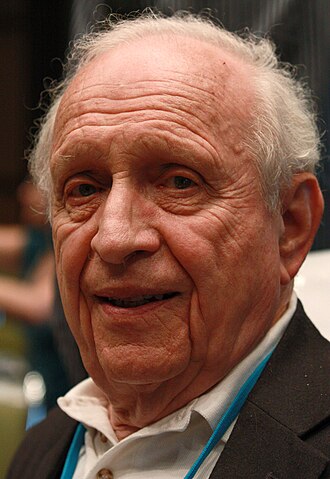
Rudolph Marcus · Science & Medicine
Theoretical chemist whose Marcus theory explains the rates of electron transfer reactions, from corrosion to photosynthesis, and co-author of the RRKM theory of reaction rates; Nobel Prize in Chemistry 1992
21 July 1923, Montreal, Quebec, Canada — 16 July 2026, Pasadena, California, United States
Montreal · Ottawa · Chapel Hill · Brooklyn · Urbana · Pasadena
Rudolph Marcus is recognized among Jewish contributors to Science & Medicine — Theoretical chemist whose Marcus theory explains the rates of electron transfer reactions, from corrosion to photosynthesis, and co-author of the RRKM theory of reaction rates; Nobel Prize in Chemistry 1992
Origins and early life
Rudolph Arthur Marcus was born in Montreal on 21 July 1923, the only child of Myer Marcus and Esther Cohen, who shared a Lithuanian Jewish heritage; his father's family had come from the town of Wilkomir, today Ukmergė. He spent part of his childhood in Detroit and grew up mostly in Montreal, at an almost entirely Jewish high school and then at McGill University, where Jewish students faced a quota and an adviser warned him that, being Jewish, he would find work harder to get in mathematics or physics.
He took his bachelor's degree there in 1943 and his doctorate in 1946, then three years at the National Research Council in Ottawa.
Work and career
Drawn to theory, in 1949 he joined Oscar Rice at the University of North Carolina, where he married Laura Hearne and developed what became the RRKM theory, still a basic tool for calculating reaction rates. At the Polytechnic Institute of Brooklyn, from 1956 to 1965, he built a theory of electron transfer between molecules in solution, explaining why some of these reactions are fast and others slow by the energy needed to rearrange the surrounding molecules.
It also predicted an inverted region, in which a reaction slows as its driving force grows, a counterintuitive result not confirmed until 1984 and now seen as key to the efficiency of photosynthesis. He moved to the University of Illinois in 1964 and in 1978 to the California Institute of Technology, where he stayed for forty-eight years.
Recognition
In 1992 he alone received the Nobel Prize in Chemistry, for his contributions to the theory of electron transfer reactions in chemical systems. He had received the National Medal of Science in 1989, published more than five hundred papers and kept an active laboratory past his hundredth birthday. He died at his home in Pasadena on 16 July 2026, five days short of his hundred-and-third birthday, survived by his three sons, Alan, Kenneth and Raymond.
Verify and go deeper with these external references.
Source: Wikipedia — Rudolph Marcus / NobelPrize.org Chemistry 1992
This page is published in seven languages from an English source. The translations are reviewed, but a mistake can still slip through. If you spot one on this profile — a wrong word, a lost date, a sentence that says something the English does not — please tell us.
Theoretical chemist whose Marcus theory explains the rates of electron transfer reactions, from corrosion to photosynthesis, and co-author of the RRKM theory of reaction rates; Nobel Prize in Chemistry 1992
Source: Wikipedia — Rudolph Marcus / NobelPrize.org Chemistry 1992