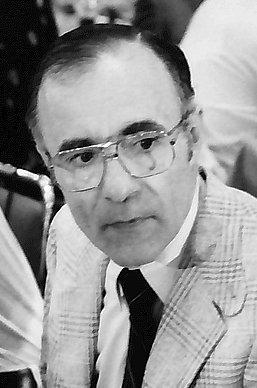
Roald Hoffmann · Science & Medicine
Theoretical chemist and child survivor of the Holocaust who with Robert Woodward set out the orbital symmetry rules for the course of chemical reactions; Nobel Prize in Chemistry 1981, shared with Kenichi Fukui; also a poet and playwright
18 July 1937, Złoczów, Poland (now Zolochiv, Ukraine)
Złoczów · Kraków · New York · Cambridge · Ithaca
Roald Hoffmann is recognized among Jewish contributors to Science & Medicine — Theoretical chemist and child survivor of the Holocaust who with Robert Woodward set out the orbital symmetry rules for the course of chemical reactions; Nobel Prize in Chemistry 1981, shared with Kenichi Fukui; also a poet and playwright
Origins and early life
Roald Hoffmann was born Roald Safran in Złoczów, Poland, now Zolochiv in Ukraine, on 18 July 1937, to Hillel Safran, a civil engineer, and Clara Rosen, a teacher, or, as he put it, to a happy Jewish family in dark days in Europe. After 1941 he and his parents were sent to a ghetto and a labour camp, and early in 1943 his father smuggled him and his mother out to a village, where a Ukrainian neighbour, Mykola Dyuk, hid them in a schoolhouse attic until the Red Army came in June 1944.
His father was killed in June 1943 after organizing a breakout attempt, and most of the family was murdered; his mother married Paul Hoffmann, whose name the boy took, and in 1949 they emigrated to the United States.
Work and career
Learning English, his sixth language, he went through Stuyvesant High School and Columbia College, and took his doctorate at Harvard in 1962, having helped to develop the extended Hückel method for calculating molecular orbitals. From 1964 he worked there with Robert Burns Woodward, and together they set out the Woodward–Hoffmann rules, which predict the course of concerted reactions from the symmetry of the orbitals involved.
He joined Cornell University in 1965 and has stayed there ever since, teaching first-year chemistry almost every year from 1966.
Recognition
In 1981 he shared the Nobel Prize in Chemistry with Kenichi Fukui, for their theories, developed independently, concerning the course of chemical reactions; Woodward could not share it, as it is given only to the living. He began publishing poetry in 1984, wrote the play Oxygen with Carl Djerassi, and presented the television course The World of Chemistry, first broadcast on PBS in 1990. In 2009 a Holocaust memorial was dedicated in the Zolochiv district on his initiative, and he remains a professor emeritus of humane letters at Cornell.
Verify and go deeper with these external references.
Source: Wikipedia — Roald Hoffmann / NobelPrize.org Chemistry 1981
This page is published in seven languages from an English source. The translations are reviewed, but a mistake can still slip through. If you spot one on this profile — a wrong word, a lost date, a sentence that says something the English does not — please tell us.
Theoretical chemist and child survivor of the Holocaust who with Robert Woodward set out the orbital symmetry rules for the course of chemical reactions; Nobel Prize in Chemistry 1981, shared with Kenichi Fukui; also a poet and playwright
Source: Wikipedia — Roald Hoffmann / NobelPrize.org Chemistry 1981