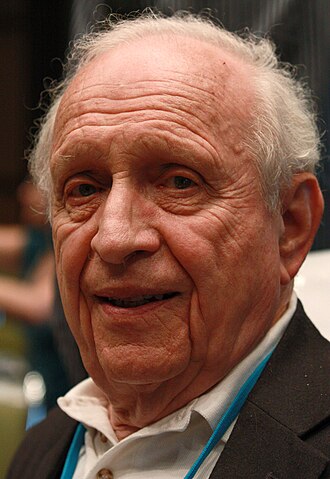
Michel Devoret · Science & Medicine
Physicist who showed quantum tunnelling and energy quantisation in a macroscopic superconducting circuit, groundwork for superconducting qubits; Nobel Prize in Physics 2025
5 March 1953, Paris, France
Paris · Saclay · Berkeley · New Haven · Santa Barbara
Michel Devoret is recognized among Jewish contributors to Science & Medicine — Physicist who showed quantum tunnelling and energy quantisation in a macroscopic superconducting circuit, groundwork for superconducting qubits; Nobel Prize in Physics 2025
Origins and early life
Michel Henri Devoret was born in Paris on 5 March 1953 and trained first as an engineer, graduating from the École nationale supérieure des télécommunications in 1975 before turning to physics at the University of Orsay. In an oral history interview recorded in 2021, he said that his parents were of Jewish background, even though they were not religious. He took his doctorate in 1982 for research at the Saclay centre of the French Atomic Energy Commission, then spent two years, from 1982 to 1984, as a postdoctoral researcher in John Clarke's laboratory at the University of California, Berkeley.
Work and career
There, in 1984 and 1985, with Clarke and John Martinis, then a graduate student, he built a circuit of superconductors separated by a thin insulating layer and showed that this system, big enough to be held in the hand, tunnels through a barrier and absorbs or emits energy only in fixed amounts. Back in France he founded the Quantronics group at Saclay with Daniel Esteve and Cristian Urbina, which invented an electron pump, observed the charge of Cooper pairs directly and built a superconducting quantum bit, the quantronium.
He joined Yale University in 2002, where with Robert Schoelkopf and Steven Girvin he helped develop the transmon, a superconducting qubit now widely used, and in 2009 he pioneered the fluxonium; from 2007 he also held the chair of mesoscopic physics at the Collège de France. In 2023 he became chief scientist for quantum hardware at Google Quantum AI, and in 2024 he moved from Yale to a professorship at the University of California, Santa Barbara.
Recognition
In 2025 he shared the Nobel Prize in Physics with John Clarke and John Martinis, “for the discovery of macroscopic quantum mechanical tunnelling and energy quantisation in an electric circuit”, work that the Royal Swedish Academy of Sciences said opens the way to quantum computers, cryptography and sensors.
Verify and go deeper with these external references.
Source: Wikipedia — Michel Devoret
This page is published in seven languages from an English source. The translations are reviewed, but a mistake can still slip through. If you spot one on this profile — a wrong word, a lost date, a sentence that says something the English does not — please tell us.
Physicist who showed quantum tunnelling and energy quantisation in a macroscopic superconducting circuit, groundwork for superconducting qubits; Nobel Prize in Physics 2025
Source: Wikipedia — Michel Devoret
Similar Contributors

Niels Bohr
Roy Glauber

Aage Bohr

Brian Josephson

Claude Cohen-Tannoudji
