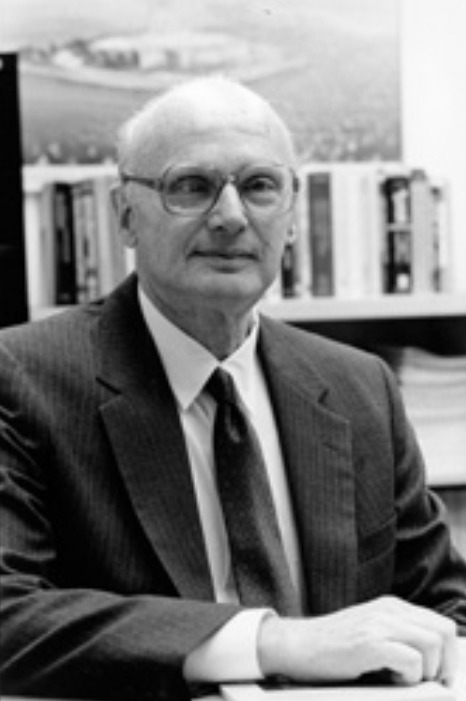
Merton Miller · Economics & Business
Modigliani–Miller theorems on capital structure and dividend policy (1958, with Franco Modigliani), foundation of modern corporate finance; Nobel Memorial Prize in Economic Sciences 1990
16 May 1923, Boston, Massachusetts, United States — 3 June 2000, Chicago, Illinois, United States
Boston · Baltimore · London · Chicago
Merton Miller is recognized among Jewish contributors to Economics & Business — Modigliani–Miller theorems on capital structure and dividend policy (1958, with Franco Modigliani), foundation of modern corporate finance; Nobel Memorial Prize in Economic Sciences 1990
Origins and early life
Merton Howard Miller was born in Boston on 16 May 1923, the only child of Joel Miller, an attorney and Harvard graduate, and of Sylvia Miller. English Wikipedia, citing the Encyclopedia of American Jewish History, describes his parents as Jewish, while his own Nobel autobiography does not mention religion. He went from the Boston Latin School to Harvard, where Robert Solow sat in the same introductory economics section, and graduated in 1943 after three years of study.
Work and career
During the war he worked as an economist in the Treasury's Division of Tax Research and then at the Federal Reserve Board, and in 1949 he went to Johns Hopkins to study under Fritz Machlup, taking his doctorate in 1952. After a year at the London School of Economics he joined the Carnegie Institute of Technology, where he and Franco Modigliani published in 1958 the first of their joint papers, The Cost of Capital, Corporation Finance and the Theory of Investment.
Their theorems showed that under simplified assumptions neither the mix of debt and equity nor the dividend policy changes a firm's market value, so that any such effect must come from taxes or other identified imperfections, which Miller went on to analyse for decades. He moved to the Graduate School of Business of the University of Chicago in 1961, stayed for the rest of his career and in 1972 wrote The Theory of Finance with Eugene Fama, his first doctoral student there.
Recognition
The 1990 Nobel Memorial Prize in Economic Sciences, shared with Harry Markowitz and William Sharpe “for their pioneering work in the theory of financial economics”, recognised in his case his fundamental contributions to the theory of corporate finance.
Later years
He sat as a public director of the Chicago Board of Trade and of the Chicago Mercantile Exchange, kept teaching after he retired in 1993, and died at his home in Chicago on 3 June 2000.
Verify and go deeper with these external references.
Source: Wikipedia — Merton Miller / NobelPrize.org Economic Sciences 1990
This page is published in seven languages from an English source. The translations are reviewed, but a mistake can still slip through. If you spot one on this profile — a wrong word, a lost date, a sentence that says something the English does not — please tell us.
Modigliani–Miller theorems on capital structure and dividend policy (1958, with Franco Modigliani), foundation of modern corporate finance; Nobel Memorial Prize in Economic Sciences 1990
Source: Wikipedia — Merton Miller / NobelPrize.org Economic Sciences 1990
Similar Contributors
Harry Markowitz

Paul Krugman

Ben Bernanke

Joseph Stiglitz

Kenneth Arrow
