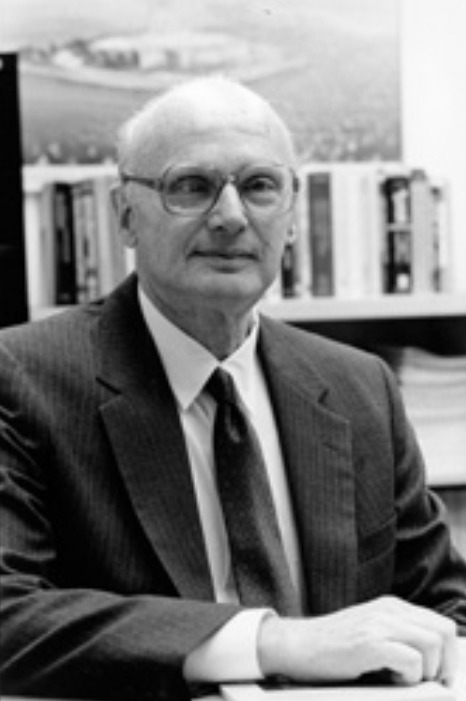
Kenneth Arrow · Economics & Business
Economist who proved the impossibility theorem of social choice and, with Gérard Debreu, the existence of a general equilibrium in a competitive economy; Nobel Memorial Prize in Economic Sciences 1972
23 August 1921, New York City, New York, United States — 21 February 2017, Palo Alto, California, United States
New York · Chicago · Stanford · Cambridge · Palo Alto
Kenneth Arrow is recognized among Jewish contributors to Economics & Business — Economist who proved the impossibility theorem of social choice and, with Gérard Debreu, the existence of a general equilibrium in a competitive economy; Nobel Memorial Prize in Economic Sciences 1972
Origins and early life
Kenneth Joseph Arrow was born in New York City on 23 August 1921 to Romanian-born Jewish parents who had come to America as infants, his mother Lilian Greenberg from Iași, his father Harry Arrow from nearby Podu Iloaiei. The family lost everything in the Great Depression and lived, as he put it, hand to mouth for some seven years. He graduated in mathematics from the tuition-free City College of New York in 1940 and took a master's at Columbia in 1941, where Harold Hotelling drew him into economics.
Work and career
After serving as a weather officer from 1942 to 1946, he joined the Cowles Commission in Chicago, married Selma Schweitzer in 1947, and at the RAND Corporation in the summer of 1948 began the work behind his impossibility theorem. His 1951 thesis proved that under general conditions no fair method can turn individual preferences into a social choice, and in 1954 he and Gérard Debreu proved that a competitive economy has a general equilibrium, a set of prices clearing every market at once.
He taught at Stanford from 1949 to 1968; his 1962 paper on learning by doing foreshadowed endogenous growth theory, and his 1963 paper on the welfare economics of medical care has set the agenda of health economics since.
Recognition
He moved to Harvard in 1968 and in 1972 shared the Nobel Memorial Prize in Economic Sciences with John Hicks, “for their pioneering contributions to general economic equilibrium theory and welfare theory”. He returned to Stanford in 1979 and retired in 1991, then chaired an Institute of Medicine study of antimalarial drugs, was a lead author for the Intergovernmental Panel on Climate Change in 1995 and received the National Medal of Science in 2004.
Later years
Several of his students, among them Eric Maskin, Roger Myerson and Michael Spence, later won the same prize, and he died at his home in Palo Alto on 21 February 2017, aged ninety-five.
Verify and go deeper with these external references.
Source: Wikipedia — Kenneth Arrow / NobelPrize.org Economic Sciences 1972
This page is published in seven languages from an English source. The translations are reviewed, but a mistake can still slip through. If you spot one on this profile — a wrong word, a lost date, a sentence that says something the English does not — please tell us.
Economist who proved the impossibility theorem of social choice and, with Gérard Debreu, the existence of a general equilibrium in a competitive economy; Nobel Memorial Prize in Economic Sciences 1972
Source: Wikipedia — Kenneth Arrow / NobelPrize.org Economic Sciences 1972
Similar Contributors

Paul Krugman

Wassily Leontief

Ben Bernanke

Joseph Stiglitz

Lawrence Klein