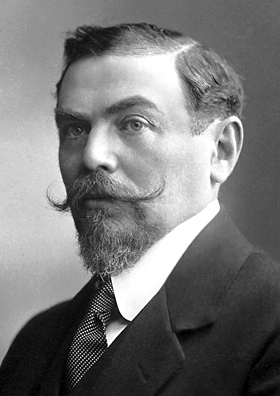
Jan Gotlib Bloch
Jan Gotlib Bloch · Philosophy & Social Sciences
Railway magnate and banker, a convert from Judaism, whose six-volume The Future of War foresaw the trenches of 1914 and inspired the first Hague Peace Conference
24 July 1836, Radom, Kingdom of Poland (Russian Empire) — 7 January 1902, Warsaw, Poland (Russian Empire)
Warsaw, Saint Petersburg, The Hague
Jan Gotlib Bloch is recognized among Jewish contributors to Philosophy & Social Sciences — Railway magnate and banker, a convert from Judaism, whose six-volume The Future of War foresaw the trenches of 1914 and inspired the first Hague Peace Conference
Origins and early life
Jan Gotlib Bloch was born in Radom, in Russian Poland, on 24 July 1836, into a poor Jewish family — his father was a dyer — and this fiche states at once what he did at fifteen: in 1851 he was baptized a Calvinist, a conversion that opened the road of business and society to him and that never separated him, in the eyes of his enemies or in his own conduct, from the Jews he came from.
Work and career
A clerk in a Warsaw bank, he made his first fortune building the Warsaw–St Petersburg railway in the 1860s, and became the 'king of the railways' of the Russian Empire, a banker, an industrialist and the founder of a school of railway economics, adviser to the Russian ministry of finance, whose statistical studies of the Empire's land, credit and industry filled a shelf. He used his wealth and his figures for the Jews: his study of the economic condition of the Jews of Russia, commissioned to answer the antisemitic legislation of the 1880s, proved with the government's own statistics that the provinces where Jews lived were the more prosperous, and was suppressed by the censor.
Later years
His fame rests on the work of his last years: The Future of War, in six volumes published in 1898, which argued from the technology of the magazine rifle, the machine gun and smokeless powder that the next great war would be decided by no battle but would sink into entrenchment, attrition, famine and revolution, ruinous to victor and vanquished alike — a prophecy the world read with interest and disregarded, and that 1914 fulfilled to the letter.
Tsar Nicholas II read it and called the first Hague Peace Conference of 1899, which Bloch attended as its unofficial apostle; he founded the International Museum of War and Peace at Lucerne, was nominated for the first Nobel Peace Prize, and died in Warsaw on 7 January 1902.
Verify and go deeper with these external references.
Source: https://encyclopedia.1914-1918-online.net/article/bloch_jan_gotlib
This page is published in seven languages from an English source. The translations are reviewed, but a mistake can still slip through. If you spot one on this profile — a wrong word, a lost date, a sentence that says something the English does not — please tell us.
Railway magnate and banker, a convert from Judaism, whose six-volume The Future of War foresaw the trenches of 1914 and inspired the first Hague Peace Conference
Source: https://encyclopedia.1914-1918-online.net/article/bloch_jan_gotlib
Similar Contributors
Alfred Fried

Eduard von Simson

Ernesto Nathan

Giuseppe Ottolenghi

Herbert Samuel
