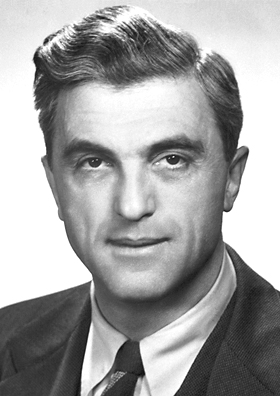
Isidor Rabi · Science & Medicine
Resonance method for recording the magnetic properties of atomic nuclei, the basis of NMR and later MRI; Nobel Prize in Physics 1944
29 July 1898, Rymanów, Galicia, Austria-Hungary (now Poland) — 11 January 1988, New York City, United States
Rymanów · New York · Ithaca · Hamburg · Cambridge, Massachusetts
Isidor Rabi is recognized among Jewish contributors to Science & Medicine — Resonance method for recording the magnetic properties of atomic nuclei, the basis of NMR and later MRI; Nobel Prize in Physics 1944
Origins and early life
Isidor Isaac Rabi was born Israel Isaac Rabi on 29 July 1898 in Rymanów, in Galicia, then in Austria-Hungary and now in Poland, and the next year his family emigrated to New York, to the Lower East Side. His parents were Orthodox Jews and Yiddish was spoken at home, but reading about Copernicus turned him away from religious belief, and for his bar mitzvah, held at home, he gave a speech in Yiddish on how an electric light works.
After a degree in chemistry at Cornell in 1919 he turned to physics, earning his doctorate at Columbia in 1927 with a thesis on the magnetic properties of crystals.
Work and career
He then spent two years in Europe with Sommerfeld, Bohr, Pauli, Stern and Heisenberg, and in Otto Stern's Hamburg laboratory he took up the molecular beams that would shape his career. Back at Columbia in 1929, at first its only Jewish faculty member, he built a molecular beam laboratory, and in 1937 and 1938 his team used an oscillating magnetic field to make atomic nuclei reveal their magnetic moments by resonance.
Recognition
He received the Nobel Prize in Physics for 1944, unshared, for his resonance method for recording the magnetic properties of atomic nuclei, from which nuclear magnetic resonance and later magnetic resonance imaging were developed. During the Second World War he was associate director of the Radiation Laboratory at the Massachusetts Institute of Technology, which developed radar, and a consultant to the Manhattan Project.
He then helped create the Brookhaven National Laboratory and, as American delegate to UNESCO, the European laboratory CERN, advised President Eisenhower on science and in 1959 joined the board of governors of the Weizmann Institute of Science in Israel.
Later years
He died of cancer at his home on Riverside Drive in Manhattan on 11 January 1988, having remarked, when examined with magnetic resonance imaging, that he had never thought his work would come to this.
Verify and go deeper with these external references.
Source: Wikipedia — Isidor Rabi
This page is published in seven languages from an English source. The translations are reviewed, but a mistake can still slip through. If you spot one on this profile — a wrong word, a lost date, a sentence that says something the English does not — please tell us.
Resonance method for recording the magnetic properties of atomic nuclei, the basis of NMR and later MRI; Nobel Prize in Physics 1944
Source: Wikipedia — Isidor Rabi