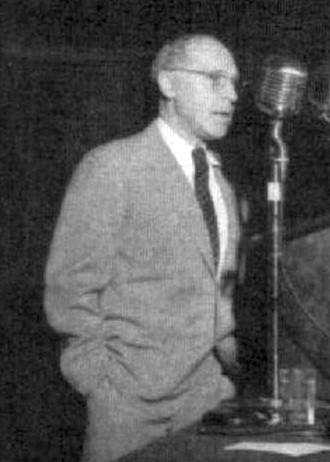
Sydney Brenner · Science & Medicine
Helped establish messenger RNA and the triplet genetic code, and made the roundworm Caenorhabditis elegans a model for the genetics of development; Nobel Prize in Physiology or Medicine 2002
13 January 1927, Germiston, South Africa — 5 April 2019, Singapore
Germiston · Johannesburg · Oxford · Cambridge · Berkeley · Singapore
Sydney Brenner is recognized among Jewish contributors to Science & Medicine — Helped establish messenger RNA and the triplet genetic code, and made the roundworm Caenorhabditis elegans a model for the genetics of development; Nobel Prize in Physiology or Medicine 2002
Origins and early life
Sydney Brenner was born on 13 January 1927 in Germiston, South Africa, where his first home was in rooms behind his father's shoe-repair shop. His parents were Jewish immigrants from Eastern Europe, his father having come from Lithuania in 1910 and his mother from Latvia in 1922, and his father, who never learned to read or write, spoke English, Yiddish, Russian, Afrikaans and Zulu.
Work and career
A town council bursary took him at fifteen, in 1942, to the University of the Witwatersrand in Johannesburg, where he was drawn into research on cells and genetics before taking his medical degrees in 1951. He went to Oxford in 1952 for a doctorate in physical chemistry, and in April 1953 drove to Cambridge to see the model of DNA that Francis Crick and James Watson had just built. In December 1956 he joined the Medical Research Council unit in Cambridge, shared an office with Crick for twenty years, and in 1960 and 1961 helped prove the existence of messenger RNA and show that the genetic code is read in triplets.
In the early 1960s he looked for a simple animal in which to study how genes build a body and its nervous system, and chose the transparent roundworm Caenorhabditis elegans. His paper of 1974 showed how mutations could be induced in the worm and linked to specific genes and to effects on development, the foundation on which John Sulston and Robert Horvitz then built. He directed the Laboratory of Molecular Biology in Cambridge from 1979 to 1986 and founded the Molecular Sciences Institute in Berkeley in 1995.
Recognition
In 2002 he shared the Nobel Prize in Physiology or Medicine with Robert Horvitz and John Sulston, “for their discoveries concerning genetic regulation of organ development and programmed cell death”. Married to May Covitz from 1952 until her death in 2010, he died on 5 April 2019, aged 92, in Singapore, where he had long helped to build biomedical research.
Verify and go deeper with these external references.
Source: Wikipedia — Sydney Brenner / NobelPrize.org Medicine 2002
This page is published in seven languages from an English source. The translations are reviewed, but a mistake can still slip through. If you spot one on this profile — a wrong word, a lost date, a sentence that says something the English does not — please tell us.
Helped establish messenger RNA and the triplet genetic code, and made the roundworm Caenorhabditis elegans a model for the genetics of development; Nobel Prize in Physiology or Medicine 2002
Source: Wikipedia — Sydney Brenner / NobelPrize.org Medicine 2002