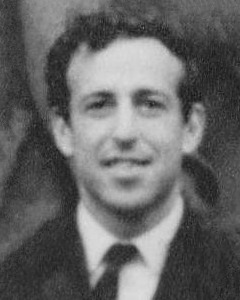
Max Perutz · Science & Medicine
Hemoglobin Structure
1914, Vienna, Austria — 2002, Cambridge, England, UK
Austria · United Kingdom (Cambridge)
Max Perutz is recognized among Jewish contributors to Science & Medicine — Hemoglobin Structure
Origins and early life
Max Ferdinand Perutz was born in Vienna on 19 May 1914 to Hugo Perutz, a textile manufacturer, and Adele Goldschmidt. The family was Jewish by ancestry and had him baptised a Catholic; he described himself in later life as without religion, and as unwilling to give offence over anyone else's. His parents wanted a lawyer, but he read chemistry at the University of Vienna, finished in 1936 and went to Cambridge to learn X-ray crystallography under J. D. Bernal, who set him on proteins.
Work and career
He chose horse haemoglobin because its crystals could be had, and the molecule occupied him for the rest of his working life. When Hitler annexed Austria in 1938 his parents escaped to Switzerland penniless; a Rockefeller grant obtained with Lawrence Bragg's backing let Perutz bring them to England in March 1939. Britain then interned him as an enemy alien and shipped him to Canada. Back in Cambridge, his knowledge of ice drew him into Project Habbakuk, a secret scheme to build an aircraft platform from frozen wood pulp, tested in a cold store beneath Smithfield meat market.
The obstacle in crystallography was the phase problem: diffraction records how strong each reflection is but loses how the waves line up, and without that the picture cannot be assembled. In 1953 Perutz showed that attaching heavy atoms to the protein and comparing the two patterns supplies the missing phases. By 1959 he had the structure of haemoglobin, the first large protein ever seen in detail, and in 1962 he shared the Nobel Prize in Chemistry with John Kendrew.
The Cambridge unit he founded and chaired became the MRC Laboratory of Molecular Biology. He died in Cambridge on 6 February 2002.
Verify and go deeper with these external references.
Source: Nobel Prize Chemistry 1962
This page is published in seven languages from an English source. The translations are reviewed, but a mistake can still slip through. If you spot one on this profile — a wrong word, a lost date, a sentence that says something the English does not — please tell us.
Hemoglobin Structure
Source: Nobel Prize Chemistry 1962
Similar Contributors
Felix Haurowitz

Ada Yonath

Alex Zunger
Alexander Rich

Amos de Shalit