Joseph Rotblat · Science & Medicine
Physicist who left the Manhattan Project on conscience; Nobel Peace Prize (1995) for the Pugwash anti-nuclear conferences
1908, Warsaw, Poland (then Russian Empire) — 2005, London, England
Poland · United Kingdom
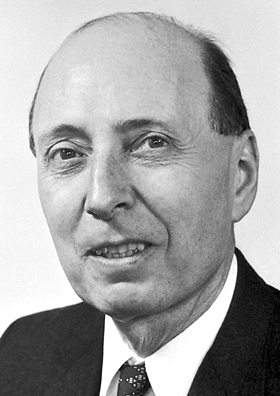
Joseph Rotblat is recognized among Jewish contributors to Science & Medicine — Physicist who left the Manhattan Project on conscience; Nobel Peace Prize (1995) for the Pugwash anti-nuclear conferences
Origins and early life
Joseph Rotblat was born on 4 November 1908 into a Jewish family in Warsaw, then under Russian rule, one of seven children of Zygmunt Rotblat, who had built up a horse-drawn carriage business across the country.
Work and career
The First World War closed the borders and the army requisitioned the horses; the business collapsed and the household fell into poverty, so that there was no money for a gymnasium and he took his secondary education in a cheder with a local rabbi, then a technical school, and worked as an electrician in Warsaw. He sat the entrance examination of the Free University of Poland in 1929, passed the physics paper with ease and failed the one on educational history entirely; the dean, Ludwik Wertenstein, who had studied under Marie Curie and Rutherford, gave him a place anyway.
He took a doctorate at the University of Warsaw in 1938, showed experimentally that fission releases neutrons, and calculated that a chain of such fissions could run in less than a microsecond — an explosion. In 1939 James Chadwick invited him to Liverpool; he went alone because he could not afford to keep his wife Tola there, returned that summer to fetch her, and left her behind ill after an operation, expecting to send for her within days.
The war closed every route out, through Denmark, Belgium and Italy in turn, and she was murdered at Belzec; he never remarried. He joined the Manhattan Project at Los Alamos in 1944 believing only a British and American bomb could deter a German one, and when it became clear at the end of that year that Germany had abandoned its own, he asked to leave on grounds of conscience — the only scientist on the project to do so.
Later years
He spent the rest of his life on the medical uses of radiation and on disarmament, signed the Russell–Einstein Manifesto in 1955, ran the Pugwash Conferences as secretary-general until 1973, shared the 1995 Nobel Peace Prize with them, and died in London on 31 August 2005.
Verify and go deeper with these external references.
Source: Jinfo.org — Jewish Nobel Peace Prize winners
This page is published in seven languages from an English source. The translations are reviewed, but a mistake can still slip through. If you spot one on this profile — a wrong word, a lost date, a sentence that says something the English does not — please tell us.
Physicist who left the Manhattan Project on conscience; Nobel Peace Prize (1995) for the Pugwash anti-nuclear conferences
Source: Jinfo.org — Jewish Nobel Peace Prize winners