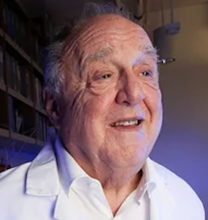
Sidney Altman · Science & Medicine
Catalytic RNA
1939, Montreal, Quebec, Canada — 2022, Rockleigh, New Jersey, United States
Canada · United States
Sidney Altman is recognized among Jewish contributors to Science & Medicine — Catalytic RNA
Origins and early life
Sidney Altman was born in Montreal on 7 May 1939 to Jewish immigrant parents from Eastern Europe: his mother Ray Arlin had come from Białystok at eighteen with her sister and worked in a textile mill to pay the passage of the rest of the family, and his father Victor, born in Ukraine and brought over as a farm labourer, kept a small grocery in Montreal. He read physics at MIT, played on its ice hockey team, spent eighteen months in a graduate programme at Columbia that gave beginners no laboratory work and left it, then took a doctorate in biophysics at Colorado in 1967 and went on to Harvard and to the Laboratory of Molecular Biology in Cambridge.
Work and career
At Yale, where he spent the rest of his career, he worked on a bacterial enzyme called ribonuclease P, which trims transfer RNA to its working length. The enzyme was made of a protein and a piece of RNA, and everyone assumed the protein did the cutting, since catalysis was what proteins were for. Altman separated the two and found the opposite: the RNA cut on its own, and the protein only helped. A molecule that carries information could also do chemistry, which meant that the old question of whether the first genes or the first enzymes came first had a possible answer in a single kind of molecule.
He shared the 1989 Nobel Prize in Chemistry with Thomas Cech, who had found catalytic RNA by another route, and died on 5 April 2022.
Verify and go deeper with these external references.
Source: Nobel Prize Chemistry 1989
This page is published in seven languages from an English source. The translations are reviewed, but a mistake can still slip through. If you spot one on this profile — a wrong word, a lost date, a sentence that says something the English does not — please tell us.
Catalytic RNA
Source: Nobel Prize Chemistry 1989