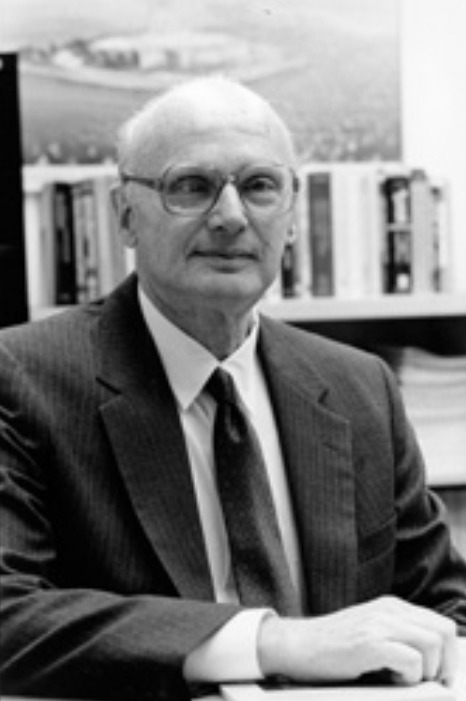
Robert Aumann · Economics & Business
Game Theory
1930, Frankfurt, Germany
Germany · United States · Israel (Hebrew University of Jerusalem)
Robert Aumann is recognized among Israeli contributors to Economics & Business — Game Theory
Origins and early life
Robert Aumann was born in Frankfurt am Main on 8 June 1930, and his family fled Germany for the United States in 1938, two weeks before the Kristallnacht pogrom. He went to the Rabbi Jacob Joseph School, a yeshiva high school in New York, took his bachelor's degree at the City College of New York in 1950, and completed a doctorate at MIT in 1955 with a dissertation on knot theory written under George Whitehead Jr.
Work and career
He settled in Israel and built his career at the Hebrew University of Jerusalem, at what became its Center for the Study of Rationality, and helped found the Center for Game Theory at Stony Brook. His subject was what happens when the same players meet again and again: in a game played once, betrayal can pay, but in a game repeated without a known end, cooperation becomes rational because a reputation has a future. That result reaches into arms control, trade negotiation and the ordinary economics of who can be trusted, and it is why his name is attached to the idea of correlated equilibrium and to the analysis of common knowledge. His eldest son Shlomo was killed in action as a tank gunner in the 1982 Lebanon War.
Recognition
He received the Israel Prize for economics in 1994, the Nemmers Prize in 1998, the Nobel Memorial Prize in Economic Sciences in 2005 with Thomas Schelling, and the city of Jerusalem's Yakir Yerushalayim award in 2006.
Verify and go deeper with these external references.
Source: Nobel Prize Economics 2005
This page is published in seven languages from an English source. The translations are reviewed, but a mistake can still slip through. If you spot one on this profile — a wrong word, a lost date, a sentence that says something the English does not — please tell us.
Game Theory
Source: Nobel Prize Economics 2005